 Alp Ünlü
Crack Formation: How a growing colony tears its own edge
Simulating how cracks open around the rim of a growing colony, in COMSOL and in a solver I wrote myself.
A growing colony can crack along its edge, much like mud drying in a puddle. My first models only made the edge wrinkle, never crack. The problem was in how they grew: the outer layer was being squeezed, and a squeezed layer buckles but cannot tear. A crack needs the material to be pulled apart.
Letting the interior grow while a thin outer band stays passive changes that. The rim is now stretched and cracks open all around it, while the squeezed interior stays intact. In COMSOL the colony ends up 29% larger, with eleven cracks around its edge.
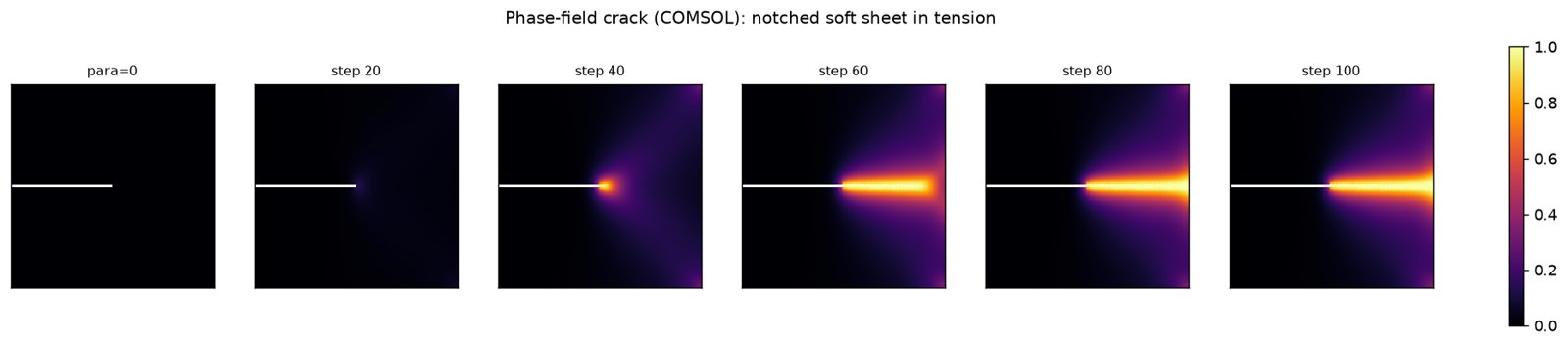
To make sure the result was not a quirk of one program, I wrote my own fracture solver in Python from scratch, with no simulation library. It reproduces the same behaviour, with eight cracks for a narrower growth band. Before the colony, I checked the approach on a simpler case: a single crack running through a stretched, notched sheet.